Tree Roots In Sewer Lines: How They Get In And What Jetting Does
Tree roots seek moisture, and a sewer line is a reliable source of it, so roots enter through joints and cracks and grow into mats that block the line. This guide explains how roots get in, what jetti
Free Call · Answered 24/7 · Local Pros Near You
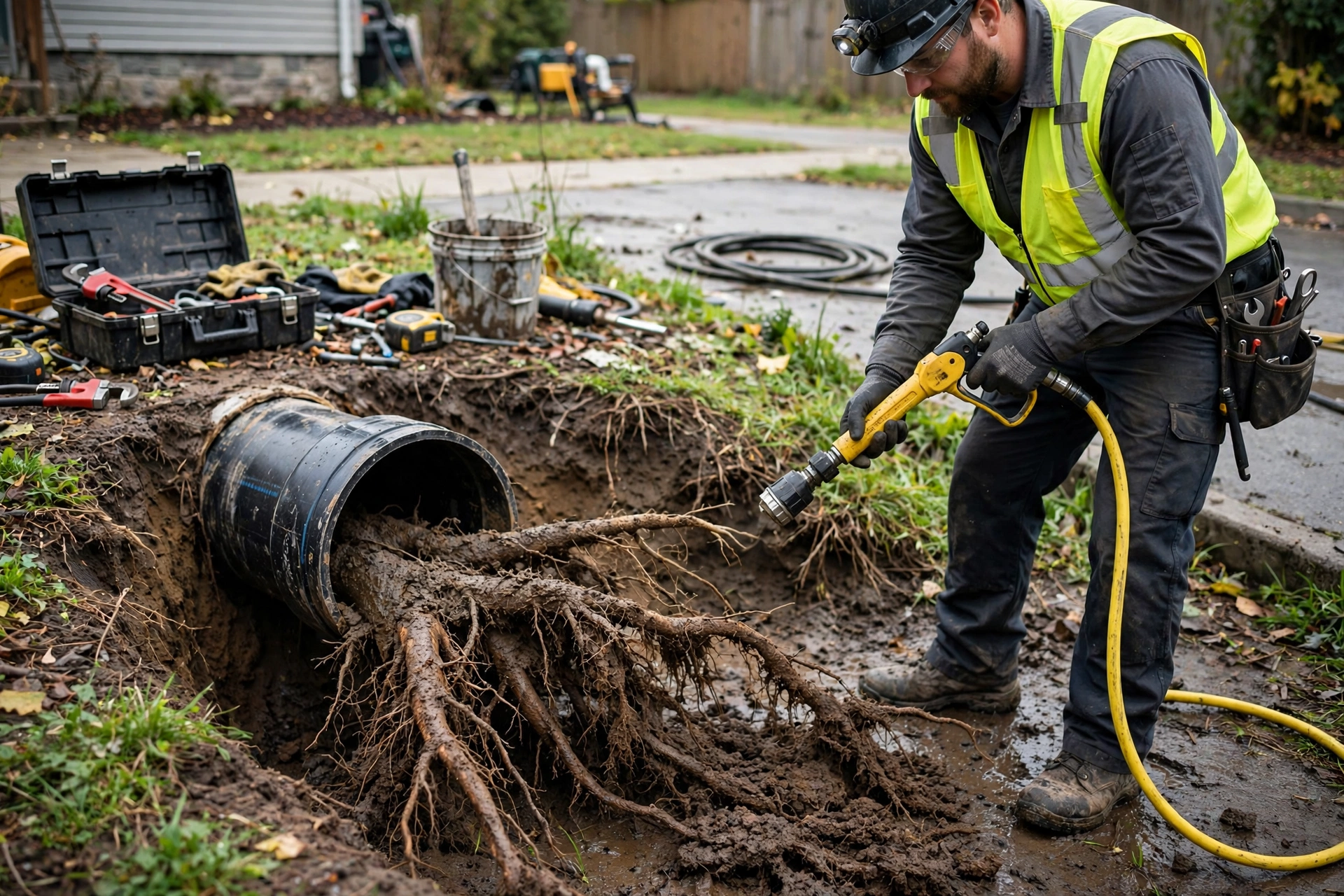
Illustrative photo, not a photograph of a real job.
Tree Roots In Sewer Lines: How They Get In And What Jetting Does
Tree roots seek moisture, and a sewer line is a reliable source of it, so roots enter through joints and cracks and grow into mats that block the line. This guide explains how roots get in, what jetting does to them, and why cutting roots without addressing the entry point only buys time.
How Roots Get In
Roots do not break sound pipe to get in; they enter through existing openings — clay joints, small cracks, and loose connections — following moisture vapour that escapes through those gaps. Once inside, a fine root grows into a mat that catches paper, grease and waste, and the mat thickens until flow slows and backups begin. Trees near a line, especially fast-growing species, increase the risk, but any tree within root range of an older lateral can be the source, and the entry point, not the tree alone, is the problem to solve.
What Jetting Does To Roots
A rotary root-cutting nozzle spins inside the line and cuts the root mat away, and a hydro jetter then flushes the cut material out, restoring flow in a sound line. That is a real clear, not a temporary poke, but it does not close the joint or crack the roots entered through, so regrowth from the same entry point is expected, often within a year or two. A camera check after cutting shows the entry point clearly, which is the information needed for the longer conversation about repair, lining, or replacement of that section.
Roots, Jetting And Repair Together
The honest pattern for root problems is: cut and flush to restore flow, camera to find the entry point, and then decide — repeat cutting on a schedule, or repair the entry point so roots cannot return. Repeat cutting is a reasonable plan where repair is not yet practical, provided the homeowner understands it is maintenance, not a cure. Ignoring roots after a clear, and waiting for the next backup, is the most expensive pattern of all, because each backup risks damage that a planned visit would have avoided.
Terms Used In This Guide
Sand and sediment settle in exterior and storm lines after heavy rain, and a jet can flush that material out. A hydro jetter pumps water at high pressure through a hose, and a local pro in Texas uses it to scour a pipe wall clean. The jetting nozzle at the end of the hose directs jets forward to break a blockage and backward to scrub the wall. Where roots are the problem, a rotary root-cutting nozzle spins inside the line to cut the growth away. A chain descaler spins against the inside of an older pipe to strip hard scale before or alongside jetting. A sewer camera sent into the line shows the blockage type and the pipe condition before and after cleaning. Access usually comes through a cleanout, the capped opening that lets a hose or camera into the line. The sewer lateral is the pipe running from a home to the public sewer main, and it is often where the trouble sits. When every drain in a home is slow at once, the main sewer line is the usual suspect rather than one branch. A grease trap catches fats, oils and grease from kitchen water before they can coat the drain system. A floor drain in a garage or laundry room can carry sludge and lint into the wider drain system. Cast iron pipe, common in older homes, can corrode and collect scale inside as it ages.
Roots enter through joints and cracks, jetting cuts and flushes the mat, and the camera shows the entry point that decides the long-term plan. Treat a root clear as the start of that plan, not as a permanent fix on its own.
Texas clay pipe joints, shifted by expansive soil, are classic root entry points, which is why root problems are common across older Texas neighbourhoods.
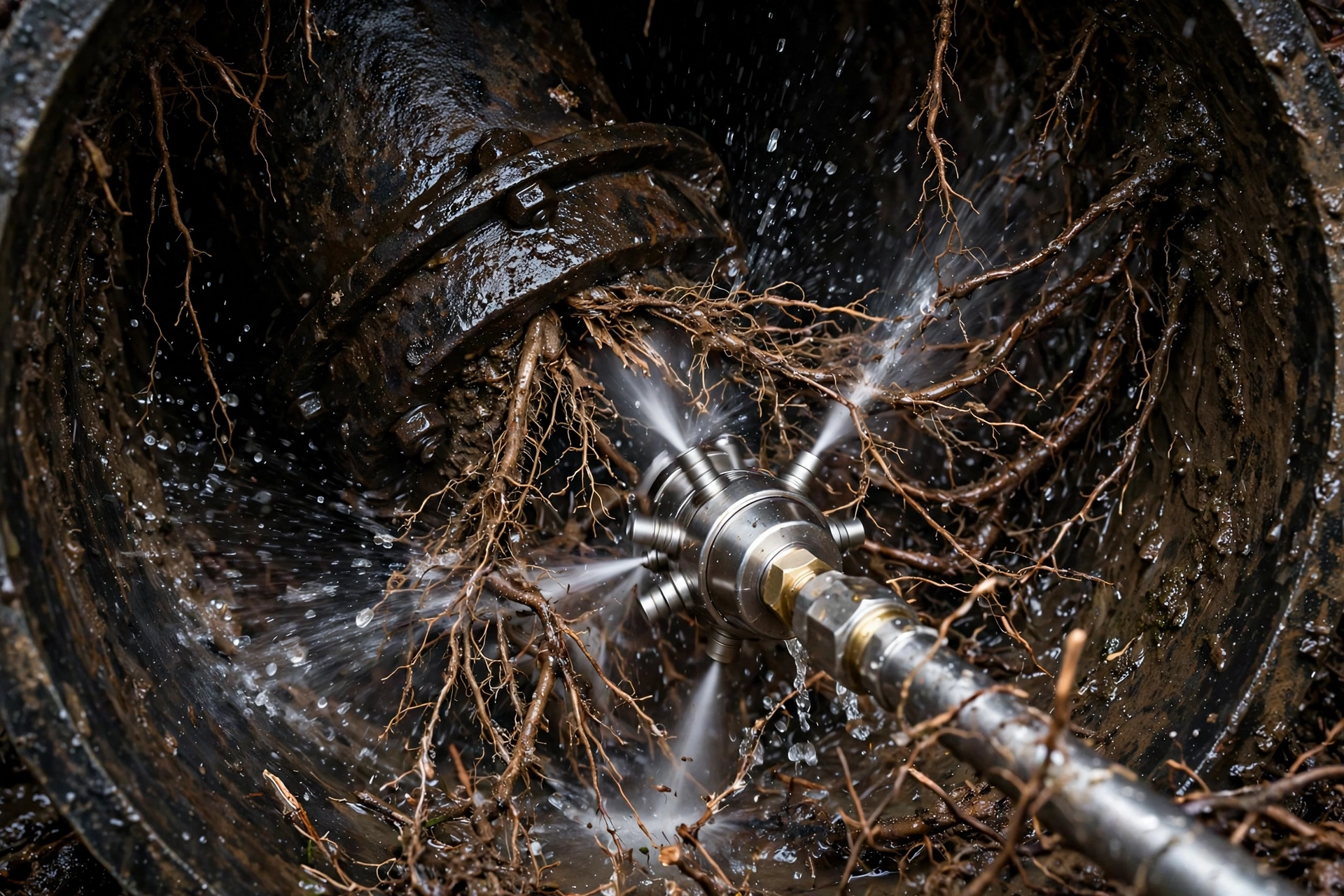
Illustrative photo, not a photograph of a real job.
Related City And State Pages
City pages in Texas relevant to this topic, plus the Texas state page.
Hydro Jetting In Austin, TX
Relevant to tree roots in sewer lines and hydro jetting in Austin: see the city page for local figures and nearby help.
Hydro Jetting In Arlington, TX
Relevant to tree roots in sewer lines and hydro jetting in Arlington: see the city page for local figures and nearby help.
Hydro Jetting In Abilene, TX
Relevant to tree roots in sewer lines and hydro jetting in Abilene: see the city page for local figures and nearby help.
Hydro Jetting In Amarillo, TX
Relevant to tree roots in sewer lines and hydro jetting in Amarillo: see the city page for local figures and nearby help.
Hydro Jetting In Texas — the Texas state page, with statewide figures and all 50 Texas cities. Also see Hydro Jetting California and Hydro Jetting Florida.
Frequently Asked Questions
Straight answers to the questions homeowners ask most.
What does Tree Roots Sewer Line Hydro Jetting actually mean?
Roots do not break sound pipe to get in; they enter through existing openings — clay joints, small cracks, and loose connections — following moisture vapour that escapes through those gaps. Once insid That plain meaning matters, because it decides whether jetting is the right tool or whether a different fix is needed first. That plain meaning is the starting point for deciding whether a camera check, a jetting visit, or a different fix is the right next step.
How do I know if Tree Roots Sewer Line Hydro Jetting applies to my home?
A rotary root-cutting nozzle spins inside the line and cuts the root mat away, and a hydro jetter then flushes the cut material out, restoring flow in a sound line. That is a real clear, not a tempora If several of those signs appear together, the problem is more likely in a shared or main line than in a single fixture. Those signs, taken together, are what a pro uses to judge whether the trouble is local, shared, or in the main line.
Does a camera check come before jetting for Tree Roots Sewer Line Hydro Jetting?
Yes, in most cases. A sewer camera shows the blockage type and the pipe condition, and that evidence decides whether high-pressure water is safe and which nozzle fits the job. Evidence from a camera, rather than a guess from symptoms, is what makes the cleaning choice safe and appropriate.
What can hydro jetting not do about Tree Roots Sewer Line Hydro Jetting?
Jetting clears what is inside a pipe, but it cannot repair a cracked, collapsed or badly offset pipe, and it cannot fix a fault outside the line. Where the camera shows damage, the pro says so plainly. Knowing the limit in advance prevents a cleaning visit from being sold as a repair, and a repair from being delayed.
How often does Tree Roots Sewer Line Hydro Jetting come up again after jetting?
The honest pattern for root problems is: cut and flush to restore flow, camera to find the entry point, and then decide — repeat cutting on a schedule, or repair the entry point so roots cannot return Regrowth, grease and scale return at different speeds, so a follow-up plan depends on the cause found, not on a fixed calendar alone. How quickly a result returns is set by the cause found, so the follow-up plan should follow the camera picture, not a fixed date.
Can I handle Tree Roots Sewer Line Hydro Jetting myself?
No risky do-it-yourself steps are recommended here. High-pressure jetting equipment can injure and can damage a weak pipe, and opening a main line without a camera check risks making a blockage worse. High-pressure equipment and weak pipes are a poor combination without training, a camera check, and the right nozzle choice.
What affects the cost of dealing with Tree Roots Sewer Line Hydro Jetting?
This site does not list prices. Cost factors include line length and depth, blockage type and severity, cleanout access, pipe material and condition, and whether a camera check is needed. A quote that follows a camera check reflects the actual line, while a quote without one is only an estimate.
When should I call about Tree Roots Sewer Line Hydro Jetting instead of waiting?
Call promptly if sewage appears, several drains fail at once, or a smell or gurgle is getting worse. Early calls usually mean a simpler clear than a full backup, and sewage inside a home is always urgent. Early action on a warning sign usually means a simpler clear, while waiting often turns a partial blockage into a full backup.
Does Tree Roots Sewer Line Hydro Jetting affect older homes differently?
Older cast iron and clay lines scale, corrode and let roots in at joints, so the same cause can be more serious in an older home. A camera check shows the actual pipe condition before any cleaning. Older pipe materials change the risk of every cleaning choice, which is why material and condition are checked first.
Who do I call about Tree Roots Sewer Line Hydro Jetting?
Call the number on this page. One free call connects you with an independent local pro, answered 24/7, who can talk through what you are seeing and arrange a visit to check the problem in person. One free call, answered at any hour, is the route to a pro who can check the line in person and confirm the problem.
Reviewed By Hamza
Master Plumber & High-Pressure Hydro Jetting Specialist
Hamza is a certified master plumber and high-pressure water jetting specialist with extensive hands-on experience restoring clogged commercial and residential drain systems across California, Texas, and Florida. He specializes in closed-circuit television (CCTV) sewer camera diagnostics, high-velocity hydro-jetting up to 4,000 PSI, rotational mechanical root milling, and heavy cast iron pipe descaling to safely eliminate stubborn obstructions, grease scale, and invasive roots without trenching or property damage.
Updated November 3, 2026
Related Guides
Guides that go deeper on connected topics.
Hydro Jetting For Older Homes: Clay, Cast Iron And Orangeburg Pipes
Related guide on a connected topic.
Preventive Jetting Schedule For Homes: How Often And Why
Related guide on a connected topic.
Cast Iron Pipe Descaling: What It Is And When Jetting Helps
The pilot guide on cast iron descaling, relevant wherever older pipes are discussed.
Need Hydro Jetting Help In Texas?
One free call connects you with a local pro, answered 24/7.
Free Call · Answered 24/7 · Local Pros Near You